

TL;DR:
- Selling a home in Nebraska involves understanding specific legal and procedural factors, such as judicial foreclosure and kick-out clauses, which influence negotiation strategies. Preparation with essential documents, leveraging experienced agents or legal support, and tracking key deadlines are vital for successful negotiations. Staying disciplined, transparent, and responsive helps sellers close faster, avoid pitfalls, and maximize their transaction value amidst financial or time pressures.
Selling a home in Nebraska while under financial pressure is stressful enough without losing thousands of dollars to negotiation mistakes. Many sellers in Lancaster, Douglas, and Sarpy counties leave money on the table or watch deals fall apart simply because they didn't understand the process before it started. A clear, step-by-step negotiation workflow gives you control over timelines, paperwork, and counteroffers so you can close faster and with less regret. This guide walks you through exactly what to do, when to do it, and what pitfalls to watch for at every stage.
Table of Contents
- Understanding the Nebraska home sale negotiation landscape
- Essential prep: Documents, timing, and negotiation team
- Step-by-step home sale negotiation workflow
- Troubleshooting: Common pitfalls and Nebraska-specific solutions
- A Nebraska expert's take: What actually matters in tough home sale talks
- Need help navigating your Nebraska home sale?
- Frequently asked questions
Key Takeaways
| Point | Details |
|---|---|
| Understand Nebraska’s rules | Every negotiation works within key state-specific rules like kick-out clauses and required disclosures. |
| Prepare documents early | Having your paperwork and timeline mapped out ensures you can act fast and avoid costly mistakes. |
| Follow a clear workflow | A sequential approach to price, offers, contingencies, and closing increases your chances of a smooth, fast sale. |
| Stay flexible and responsive | Quick, well-documented responses to offers can help you avoid delays and improve your negotiating position. |
Understanding the Nebraska home sale negotiation landscape
Before you price your home or accept a single offer, you need to understand how Nebraska's legal and procedural environment shapes every negotiation. Nebraska is a judicial foreclosure state, which means courts are involved in foreclosure proceedings. That matters to you as a seller because buyers who fear foreclosure timelines may push harder on contingency protections, affecting your negotiating position from the start.
One of the most important terms you'll encounter is the kick-out clause. This is a provision that lets you keep marketing your home even after you've accepted a contingent offer from a buyer who still needs to sell their own property. Kick-out clauses in Nebraska are common for contingent offers and typically run 30 to 60 days, with sellers required to give buyers 24 to 72 hours to respond if a better offer comes along. Knowing this timeline before you sign anything is critical.
Nebraska sellers are also required to provide a disclosure statement covering known property defects. Skipping this or being vague creates legal exposure that can delay or kill deals at the worst possible time. You'll also pay a transfer tax of $2.25 per $1,000 of the sale price at closing, which happens at a title company rather than a courthouse or law office. These Nebraska negotiation strategies are built around this specific legal and procedural framework, not generic real estate advice.
Here's a quick reference of the key state-specific elements:
| Element | Nebraska Detail |
|---|---|
| Foreclosure type | Judicial state |
| Kick-out clause duration | 30 to 60 days |
| Buyer response window | 24 to 72 hours |
| Seller disclosure | Required by law |
| Transfer tax | $2.25 per $1,000 of sale price |
| Closing location | Title company |
Understanding these factors lets you map your negotiation workflow around real deadlines rather than guesses. Sellers who skip this step often get surprised mid-deal when a buyer invokes a contingency they didn't fully understand.
Statistic callout: Nebraska's transfer tax on a $200,000 home equals $450 at closing. On a $350,000 home, that's $787.50. Small percentages add up fast when you're already dealing with repairs, agent fees, or financial pressure.
Essential prep: Documents, timing, and negotiation team
Once you grasp the negotiation landscape, the right preparation prevents costly mistakes. Sellers who walk into negotiations unprepared almost always react instead of lead. You want to be the person who already has answers when questions come up.
Documents you need ready before any offer arrives:
- Completed Nebraska seller disclosure statement
- Survey or plot map (especially important for older properties)
- Utility bills from the last 12 months
- HOA documents if applicable, including fees and bylaws
- Permits for any unpermitted work or additions
- Title insurance policy or prior title search
- Mortgage payoff statement from your lender
- Any existing inspection reports
The more documentation you have ready upfront, the less leverage a buyer has to demand delays or price reductions during due diligence. Addressing seller disclosures in Nebraska honestly and early builds credibility with buyers and protects you legally.

Who should be on your negotiation team?
| Role | With an agent | Without an agent |
|---|---|---|
| Pricing strategy | Agent provides CMAs | You research Zillow, county records |
| Contract drafting | Agent handles forms | Use Nebraska-approved forms or attorney |
| Offer response | Agent advises, you decide | You decide alone, faster |
| Escrow and title | Title company handles | Title company still handles |
| Legal protection | Agent + title company | You + title company (attorney optional) |
| Cost | 3 to 6% commission | Potentially zero commission |
Top agents understand escalation clauses (where buyers automatically bid above competitors up to a set limit) and real estate negotiation nuances like appraisal gaps. They also help you stay calm when negotiations get tense, which is one of the most underrated skills in any real estate deal. That said, if you're selling a distressed property fast, selling without an agent can cut significant costs and time.
Key dates to track in your workflow:
- Kick-out clause start date and expiration
- Buyer's home sale contingency deadline
- Inspection window (typically 7 to 14 days after contract)
- Appraisal deadline (usually tied to financing contingency)
- Final walkthrough date
- Closing date at title company
Pro Tip: Create a simple calendar with every deadline the moment you go under contract. Color code buyer deadlines in red and your response windows in blue. Missing a 48-hour response window on a kick-out clause can legally lock you into a weaker deal.
Understanding Nebraska real estate laws around these timelines is worth an hour of your time before you list. The rules favor prepared sellers.
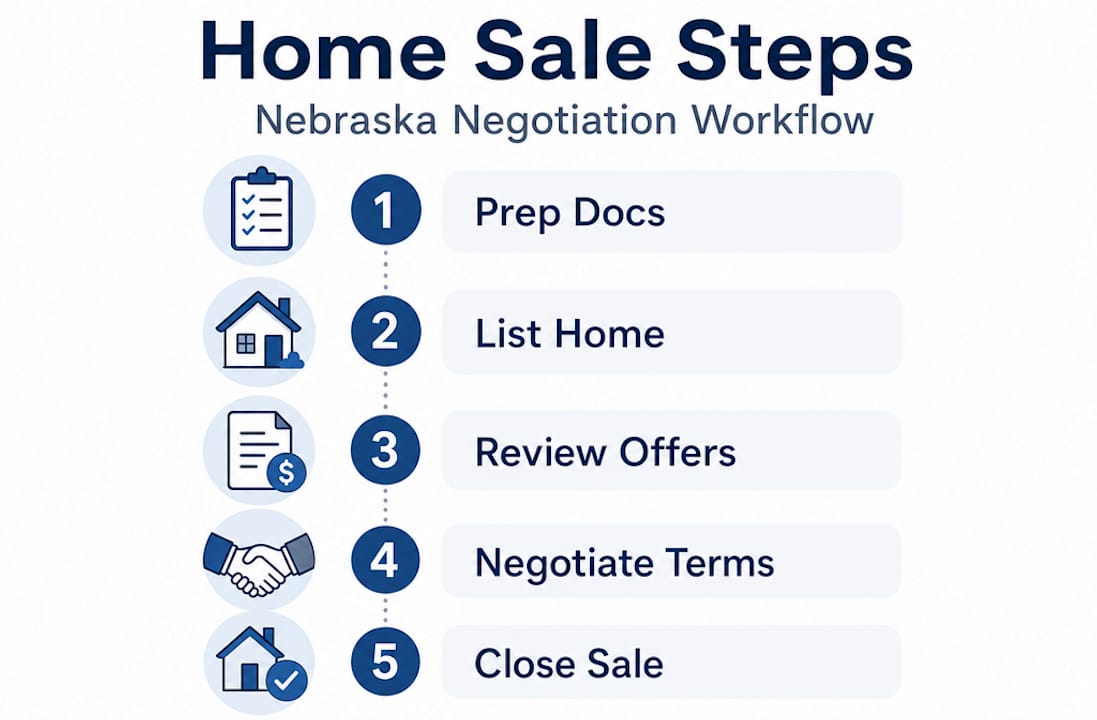
Step-by-step home sale negotiation workflow
Now that you're prepared, let's walk through each workflow stage with clear, concrete steps.
-
Set your price strategically. Pull comparable sales (comps) from the last 90 days within a one-mile radius in your specific county. In Sarpy or Douglas County, local market conditions can differ from statewide averages. Price slightly above your absolute minimum to create room for negotiation without looking desperate.
-
List and disclose upfront. Post your listing with all documentation attached. Uploading your disclosure statement to the listing reduces buyer hesitation and limits renegotiation attempts after inspection. This step alone saves many sellers 5 to 10 days of back-and-forth.
-
Evaluate every offer on total terms, not just price. A higher offer with a weak contingency package can cost you more than a slightly lower clean offer. Review: earnest money amount, contingencies included, financing type, closing timeline, and any requests for closing cost contributions.
-
Respond within your legal window. Nebraska contracts include response deadlines. If a buyer offers and you sit on it too long, the offer expires. If you're under a kick-out clause, your response window to an incoming competing offer is only 24 to 72 hours per Nebraska kick-out rules.
-
Issue a counteroffer in writing. Every change to price, timeline, or terms must be documented in writing. Verbal agreements are unenforceable. Countering in writing also creates a clear paper trail if disputes arise before closing.
-
Handle escalation clauses carefully. If a buyer submits an escalation clause, ask for proof of the competing offer before agreeing to the escalated price. Some buyers use them speculatively. Top agents handle escalation clauses by verifying offers and keeping negotiations orderly.
-
Manage contingency timelines actively. Track every deadline your buyer has to waive or fulfill a contingency. If they miss a deadline, you may have the right to terminate or renegotiate. Don't assume they'll tell you when they've met conditions.
-
Navigate appraisal gaps proactively. If an appraisal comes in below the agreed price, you have three options: lower the price to match, ask the buyer to cover the gap in cash, or split the difference. Knowing your minimum before this happens prevents panic decisions.
-
Complete the final walkthrough coordination. Schedule this 24 hours before closing. Any new damage discovered gives the buyer grounds to renegotiate or delay. Walk the property yourself before they do.
-
Close at the title company with all documents ready. Show up with valid ID, your mortgage payoff confirmation, and any agreed credits in writing. Transfer tax is calculated and collected at this stage.
"Document everything. Every counteroffer, every verbal agreement turned written, every contingency waiver. The sellers who run into legal trouble at closing are almost always the ones who trusted handshakes over paperwork."
For a broader picture of each phase, the step-by-step home selling guide covers what to expect from listing through final signature.
Pro Tip: Always respond to offers in the morning when possible. Afternoon responses get buried in evening routines. Early morning replies show urgency and keep momentum in your favor.
Troubleshooting: Common pitfalls and Nebraska-specific solutions
Even the best preparation can run into snags. Here's how to stay in control when issues appear.
The most common negotiation breakdowns and how to fix them:
-
Missed kick-out deadlines. If you accept a contingent offer and get a second offer but don't notify the original buyer properly, you may lose the right to invoke the kick-out clause. Always send kick-out notifications in writing through your title company or attorney, not just by text or phone.
-
Vague disclosure statements. Sellers who describe issues with words like "possible" or "minor" invite buyers to use inspection results as leverage. Be specific. "Roof replaced in 2017, no current leaks" is stronger than "roof may need attention."
-
Appraisal gap panic. A low appraisal feels like disaster, but it's a normal part of the market. Nebraska distressed sellers often face this with older or unmaintained properties. Have a number in mind before the appraisal arrives. Know whether you'll negotiate or walk.
-
Contingency confusion. Buyers sometimes miss their own deadlines, not realizing that a missed financing contingency waiver date can void their protection. Track their deadlines as carefully as your own. If they default, you need to know it immediately.
-
Emotional overreaction to lowball offers. In Lancaster County especially, investors and buyers looking for undervalued properties often open low. That's not disrespect, it's strategy. Counter calmly with data: your comps, your disclosure status, your closing flexibility.
-
Ignoring title issues until closing day. Run a preliminary title search early. Liens, unpaid property taxes, or easement disputes discovered at the last minute derail closings and cost far more in delays than they would have cost to resolve in advance.
Statistic callout: According to kick-out clause data, sellers who mismanage contingency timelines in Nebraska face delays averaging two to four weeks, which often leads to buyers renegotiating price or walking away entirely.
If you're facing serious timeline pressure or financial hardship, fast solutions for distressed sellers exist outside the traditional listing process and can eliminate most of these complications entirely.
A Nebraska expert's take: What actually matters in tough home sale talks
Armed with the workflow, let's see which negotiation tactics hold up in real Nebraska deals. After working with homeowners across Lancaster, Douglas, and Sarpy counties, one thing becomes clear: discipline around paperwork and timeline management beats pressure tactics every single time.
Most homeowners think negotiation is about holding firm on price. The reality is that sellers who close the best deals are the ones who respond fast, disclose honestly, and stay calm when buyers push back. Buyers sense desperation in slow responses just as clearly as they see it in price cuts.
Here's the uncomfortable truth for distressed or undervalued property sellers: rigid price targets often hurt more than they help. If your property needs work and you know it, pricing it as if it doesn't sends a message that you're not being honest. Buyers who want fixer-uppers are looking for transparency and speed. They don't want to fight for every concession. Give them a fair price, clean disclosures, and a firm close date, and you'll attract better offers than a seller who overprices and haggles.
The sellers who struggle most are the ones trying to control things outside their reach: the market, buyer financing, appraisal values. Focus instead on what you can control: your disclosure quality, your response time, your flexibility on closing dates, and your ability to stay emotionally neutral during counteroffers.
Expert-level real estate negotiation isn't about being the toughest person in the room. It's about being the most organized, most responsive, and most credible. Those qualities translate directly into fewer renegotiations and faster closings. And if you're trying to maximize as-is home value, that credibility matters even more because you're asking buyers to accept the property with known imperfections.
Need help navigating your Nebraska home sale?
If you've read this far and still feel like the process is overwhelming or your situation doesn't fit the traditional timeline, you're not alone. Many homeowners in Lancaster, Douglas, and Sarpy counties are dealing with financial pressure, inherited properties, or homes that need significant work before a conventional buyer will even look twice.
At Enko Home Buyers, we buy off-market homes directly from homeowners who need a faster, simpler path to closing. No listings, no waiting for financing contingencies, no appraisal surprises. If you want to sell your Nebraska home fast with a cash offer and a flexible close date, we can give you a no-obligation offer quickly. We also work with landlords who want a cash offer for rental property without the hassle of finding retail buyers. Reach out today and find out what your home is worth in a direct sale.
Frequently asked questions
What is a kick-out clause in Nebraska home sales?
A kick-out clause lets the seller keep marketing their home after accepting a contingent offer, allowing them to accept a better offer if one comes along. Per Nebraska kick-out rules, the original buyer then has a set window to respond or lose the contract.
How long does a kick-out clause usually last in Nebraska?
It typically lasts 30 to 60 days, and buyer response windows run 24 to 72 hours once the seller notifies them of a competing offer.
What documents are required for a Nebraska home sale?
Sellers must provide a disclosure statement covering known defects, and Nebraska law requires all transfer paperwork to be completed before closing at a title company.
What transfer taxes apply when selling in Nebraska?
The state transfer tax is $2.25 per $1,000 of the final sale price, collected at the title company on closing day.