

TL;DR:
- Nebraska law requires full disclosure of material defects even in as-is home sales.
- Selling as-is is often used for quick sales, especially in pre-foreclosure or distressed properties.
- Proper disclosure and honest pricing are essential to avoid legal issues after an as-is sale.
Many Nebraska homeowners believe that slapping "as-is" on a listing is a legal force field. Sign the contract, walk away, and whatever the buyer finds after closing is their problem. That belief is wrong, and acting on it can land you in court. An as-is home sale means you're not required to make repairs, upgrades, or issue credits, but you are still legally required to disclose every known material defect. This guide walks you through what as-is really means under Nebraska law, the specific local risks that catch sellers off guard, and the practical steps that protect you while still getting your home sold fast.
Table of Contents
- What does 'as-is' really mean in Nebraska?
- Nebraska's biggest as-is disclosure risks
- Pros and cons of selling as-is in pre-foreclosure or for repairs
- How to sell as-is safely and successfully in Nebraska
- Why 'as-is' works—if you respect Nebraska's realities
- Get cash offers for your as-is Nebraska home—no repairs needed
- Frequently asked questions
Key Takeaways
| Point | Details |
|---|---|
| Disclosure still required | Nebraska law makes full disclosure mandatory even in as-is home sales. |
| Local risks matter | Clay foundations, radon, hail, and flooding are major Nebraska resale risks requiring transparency. |
| Fast but not effortless | As-is sales enable quick deals but come with lower pricing and smaller buyer pools. |
| Pre-listing inspection helps | Getting an inspection before listing clarifies issues and supports realistic pricing. |
| Expert help pays off | Selling to local professionals or investors versed in Nebraska law minimizes your risk. |
What does 'as-is' really mean in Nebraska?
The phrase "as-is" describes the condition of the sale, not the limits of your legal responsibility. It tells buyers that what they see is what they get and that you won't be making repairs before closing. That part most sellers understand correctly. Where the myth breaks down is the assumption that the clause somehow eliminates the need to be honest about what you know.
Nebraska law requires sellers to complete a Seller Property Condition Disclosure Statement before any purchase agreement is signed. This form covers structural issues, water intrusion, electrical problems, environmental hazards, and much more. Skipping it or submitting an incomplete form is not protected by an as-is clause. Courts have consistently ruled that fraud exceptions apply and that an as-is clause does not override the duty to disclose.
Here's what an as-is sale does and does not protect you from:
- Does protect you from: Repair requests after inspection, credits for cosmetic issues, buyer demands for upgrades before closing
- Does NOT protect you from: Failing to disclose a leaking roof you knew about, hiding past flooding, omitting foundation cracks, concealing prior pest infestations
- Does NOT protect you from: Federal requirements tied to financing programs like FHA or VA loans, which may flag safety issues regardless of as-is language
"An as-is home sale means the seller offers the property in its current condition without obligation to make repairs or provide credits, but must still disclose all known material defects per state and federal law." — Rocket Mortgage
One of the most common mistakes sellers make when selling a problem property in Nebraska is assuming the contract language does the heavy lifting. It does not. Your honesty on the disclosure form is what actually protects you legally.
Nebraska's biggest as-is disclosure risks
Nebraska has a set of property hazards that sellers in other states simply don't deal with at the same scale. If you're planning an as-is sale, these are the issues most likely to come back and bite you if you leave them off the disclosure form.
| Issue | Typical Repair Cost | Disclosure Required? |
|---|---|---|
| Clay soil foundation cracks | $35,000 to $120,000 | Yes |
| Radon gas levels above EPA limit | $800 to $2,500 (mitigation) | Yes |
| Hail-damaged roof | $18,000 to $45,000 | Yes |
| Past flooding or water intrusion | Varies widely | Yes |
| Known mold from water damage | $2,000 to $30,000+ | Yes |
The clay-heavy soils common across eastern Nebraska, including Lancaster, Douglas, and Sarpy counties, expand and contract dramatically with moisture changes. This puts constant pressure on foundations and causes cracks that can compromise the structural integrity of a home over time. If you know the foundation has moved, settled, or cracked, that goes on the disclosure form. Period.

Radon is another issue unique to this region. Nebraska consistently ranks among states with higher-than-average radon levels. If you've had a radon test done and the results exceeded the EPA action level of 4 picocuries per liter, that result must be disclosed.
Hail damage is almost a Nebraska rite of passage. If your roof took a hit and you filed an insurance claim, or if you know there's damage that was never repaired, a buyer who later finds out you knew will have legal grounds to pursue you even after closing.
Estate and probate sales come with their own wrinkle. If you're selling an inherited home in Nebraska, the disclosure rules shift slightly. You are only required to disclose what you actually know. If you never lived in the property, you can indicate limited knowledge on the form. However, if you became aware of issues through inspections, family conversations, or reviewing maintenance records, that knowledge counts and must be included.
Pro Tip: Before listing, pull any available records from the county assessor's office, prior inspection reports if you have them, and insurance claim history. Getting ahead of these facts protects you and builds credibility with buyers evaluating distressed property solutions in the area.
FHA and VA loan buyers create another complication. These programs require the property to meet minimum safety and livability standards. If your home has major structural damage, active roof leaks, or electrical hazards, an FHA or VA appraiser may flag the property and block financing entirely. This narrows your buyer pool significantly, which is why many as-is sellers in Nebraska end up working with cash buyers.
Pros and cons of selling as-is in pre-foreclosure or for repairs
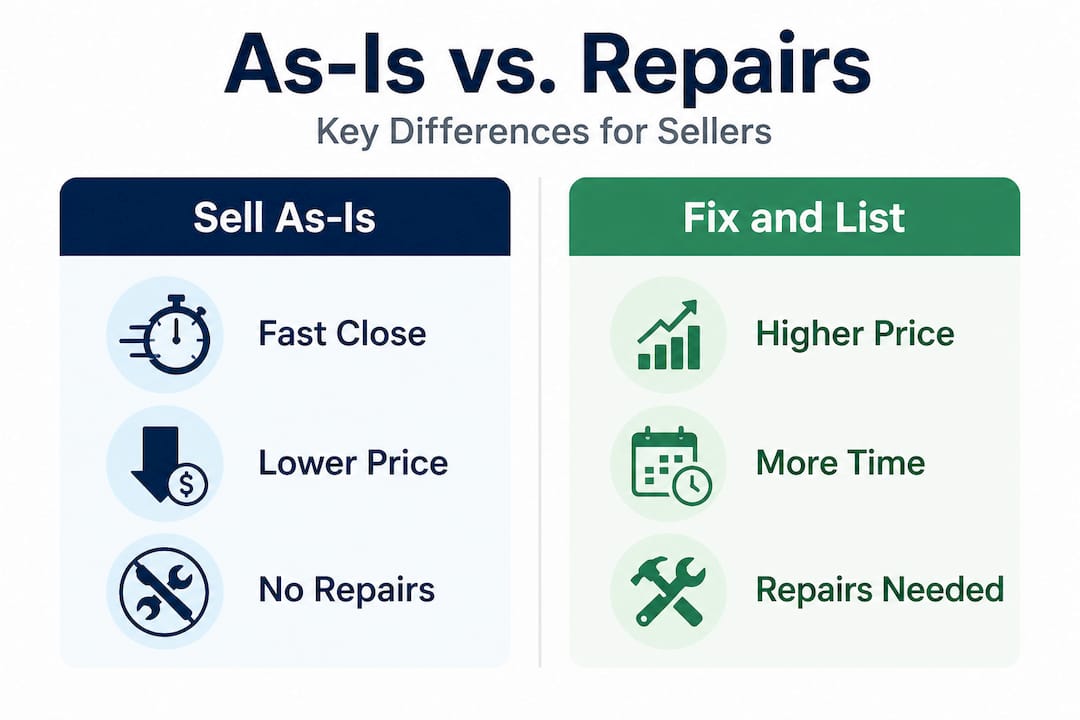
Knowing the legal landscape is only half the battle. You also need a clear-eyed view of how selling as-is stacks up against the alternative of fixing and listing on the traditional market.
| Factor | Selling As-Is | Fixing and Listing |
|---|---|---|
| Time to close | Often 7 to 30 days with cash buyers | Typically 60 to 120 days |
| Out-of-pocket repair costs | None | Can be $10,000 to $80,000+ |
| Sale price | Below market value | Closer to or at market value |
| Buyer pool | Investors and cash buyers | Broader, including financed buyers |
| Stress level | Lower | Higher |
| Risk of deal falling through | Lower with cash buyers | Higher with financed buyers |
For homeowners facing pre-foreclosure, an as-is sale is often the only realistic path. The foreclosure process in Nebraska can move quickly once a lender files a lawsuit, and there simply isn't time to fix a foundation, reroof a house, and run through a traditional 90-day listing. Speed becomes the priority, and fast home sale strategies focus on finding buyers who can close before the bank does.
Here's a realistic look at the as-is selling process from start to finish:
- Gather your disclosure paperwork. Collect inspection reports, insurance claims, permits, and any records you have about known defects.
- Decide on pricing. An as-is home is typically priced 10% to 20% below comparable homes in move-in condition, depending on severity of issues.
- Target the right buyers. Reach out to cash buyers, real estate investors, and home buying companies familiar with the Nebraska market.
- Negotiate with full transparency. Buyers who understand what they're getting are less likely to back out or sue later.
- Review the contract carefully. Make sure the as-is language is clearly included and that both parties acknowledge the condition.
Pro Tip: Consider ordering a pre-listing inspection even on an as-is sale. Experts recommend this step for pricing transparency because it shows buyers you're being straightforward about the property's condition, which actually makes them more confident and more willing to commit. Sellers who skip this step sometimes end up with deals falling apart during the buyer's inspection, which costs time and money.
The main downside of selling as-is is the lower sale price. If your home in Omaha or Lincoln is worth $250,000 in full repair condition but needs $60,000 in work, you might realistically expect offers in the $165,000 to $185,000 range. That gap feels significant, but subtract the cost of repairs, holding costs, agent commissions, and months of mortgage payments, and the net difference often narrows considerably.
How to sell as-is safely and successfully in Nebraska
The right process protects you legally and gets your home sold without drama. Here's how to handle it step by step, even if the property is in rough shape or you're working against a foreclosure deadline.
- Complete the Nebraska Seller Property Condition Disclosure Statement accurately. Fill it out with care and honesty. If you're unsure about something, note that uncertainty rather than leaving it blank or guessing.
- Get a pre-listing inspection. A licensed inspector will document existing issues, which you can then use to set a realistic price and show buyers you have nothing to hide. Pre-listing inspections take the guesswork out of negotiations.
- Price the home based on real numbers. Look at comparable sales in your area, then subtract realistic repair costs. Overpricing an as-is home causes it to sit on the market and signals to buyers that something is off.
- Prioritize cash buyers and investors. They understand as-is purchases, move faster, and don't depend on appraisals or lender approvals that could unravel the deal.
- Consult a real estate attorney in Nebraska. If your property has significant known defects, a 30-minute consultation can clarify your obligations and reduce legal risk considerably.
"Sellers who disclose fully and price honestly rarely face legal trouble after an as-is closing. The ones who get sued are almost always the ones who knew something and chose not to share it."
This is particularly critical if you're following a step-by-step selling guide during pre-foreclosure. Every day counts when you're trying to stop a foreclosure sale, and deals that fall apart because of undisclosed issues waste time you don't have.
Pro Tip: Write a brief "property story" to share with serious buyers. Describe what you know about the home's history, any repairs made, and known issues. It sounds counterintuitive, but buyers trust sellers who lead with honesty. That trust translates into stronger offers and fewer last-minute negotiations.
Avoid the common mistake of trying to "clean up" cosmetic issues while hiding structural ones. A fresh coat of paint over a water-stained ceiling is exactly the kind of thing that ends up in court. Nebraska courts take fraudulent concealment seriously, and an as-is clause provides zero protection when intentional hiding is involved.
Why 'as-is' works—if you respect Nebraska's realities
Here's something most guides won't say plainly: the sellers who get into legal trouble after as-is sales aren't typically bad people. They're scared people. They know about the foundation crack or the radon test result, and they think disclosing it will kill the deal. So they stay quiet and hope for the best.
The problem is that hope is not a legal strategy. As the Nebraska Seller Disclosure Guide 2026 makes clear, courts enforce disclosure requirements over as-is clauses when fraud is involved. Judges don't look at the contract language in isolation. They look at what the seller knew and when they knew it.
The sellers who walk away from as-is deals cleanly are the ones who treat disclosure as an asset, not a liability. In the Nebraska distressed property guide context, this means being specific about local risks. Telling a buyer upfront, "The home tested at 6.2 picocuries per liter for radon and we never installed mitigation," is powerful. It shows integrity and lets the buyer price that in, rather than feeling deceived when their own inspector finds it.
The real value of an as-is sale is time. It eliminates the inspection-repair-renegotiation cycle that slows traditional sales down. But you only get to capture that time advantage if you've done the disclosure work correctly. Skip it, and you're not saving time. You're borrowing it, with legal interest due later.
Nebraska's soil, weather, and older housing stock in places like North Omaha or older Lincoln neighborhoods create real and specific risks. Sellers who acknowledge those realities in the disclosure process and price accordingly close deals. Sellers who pretend those realities don't exist end up in depositions.
Get cash offers for your as-is Nebraska home—no repairs needed
If you're facing pre-foreclosure or dealing with a home that needs serious work, the information in this article should make one thing clear: you can sell as-is and protect yourself legally, but you need buyers who understand what that means.

Enko Home Buyers purchases off-market homes throughout Lancaster, Douglas, and Sarpy counties, specifically properties that need work. There's no need to fix anything before we make you an offer. We understand Nebraska's disclosure requirements, work directly with sellers, and can close on your timeline. Whether you need to sell your Nebraska home fast before a foreclosure date, unload a rental property that's become a burden, or simply want a transparent cash offer without listing hassles, we're ready to talk. If you're trying to stop foreclosure fast, reach out today and find out what your home is worth as-is.
Frequently asked questions
Are sellers required to fix anything in an as-is home sale in Nebraska?
No, sellers do not have to make repairs in an as-is sale, but they must fully disclose all known material defects before the purchase agreement is signed under Nebraska law.
Can I sell a Nebraska home as-is if it has major foundation or flood damage?
Yes, but full disclosure is required, and your buyer pool will likely be limited to cash buyers since foundation or flood damage at that scale can disqualify a property from FHA and VA financing.
Does selling as-is protect me if buyers find undisclosed problems later?
No, the as-is clause does not shield you from lawsuits when known issues are hidden. Nebraska courts enforce disclosure requirements over as-is contract language when fraud or concealment is involved.
What types of buyers purchase as-is homes in Nebraska?
Primarily cash buyers and real estate investors, since financing hurdles make it difficult for traditional buyers to close on distressed or heavily damaged properties through conventional lenders.