

TL;DR:
- Nebraska homeowners can sell their property before foreclosure confirmation to stop the process.
- Real estate investors offer quick, cash, as-is sales that can pause foreclosure proceedings.
- Selling pre-foreclosure provides a faster resolution with fewer costs compared to traditional listings.
Most Nebraska homeowners facing foreclosure assume they have no real options once the process starts. That assumption costs them time, money, and peace of mind. The truth is, Nebraska's foreclosure timeline is longer than most people realize, and there's a genuine window to sell your property, stop the clock, and walk away without a foreclosure on your record. Real estate investors are often the fastest path through that window. They buy distressed properties as-is, move quickly, and work directly with homeowners in Lancaster, Douglas, and Sarpy counties who need a clean exit without the delays of a traditional sale.
Table of Contents
- Nebraska foreclosure timelines and your options
- How real estate investors help Nebraska homeowners
- Comparing investor sales and traditional listings
- What to expect from investors: process, pricing, pitfalls
- Expert perspective: Why real estate investors are changing the Nebraska market
- Connect with local investors for a fast sale
- Frequently asked questions
Key Takeaways
| Point | Details |
|---|---|
| Foreclosure timeline matters | You have 142-180 days to sell a Nebraska property before court-confirmed auction pauses foreclosure. |
| Investors buy fast | Real estate investors can purchase distressed homes quickly, often as-is, speeding up the sale process. |
| Investor sales pause foreclosure | A signed contract with an investor can pause pre-foreclosure proceedings, helping protect your credit. |
| Compare sales options | Know the pros and cons of investor sales versus traditional listings to make the best choice for your situation. |
| Prepare for the process | Have necessary documents ready and understand negotiation tips when working with real estate investors. |
Nebraska foreclosure timelines and your options
Nebraska uses a judicial foreclosure process, which means the lender must file a lawsuit and get court approval before selling your home at auction. That legal requirement actually works in your favor. The Nebraska foreclosure process typically runs 142 to 180 days from default to auction confirmation, giving you a meaningful runway to act.
Pre-foreclosure begins after roughly 90 to 120 days of missed payments. Your lender files a Notice of Default, and the court process kicks off. But here's what most homeowners don't realize: you can pursue foreclosure sale options at any point before the court confirms the auction. That confirmation is the hard stop. Before it happens, the door is open.
Important: According to Nebraska foreclosure laws, a sale before auction can pause or stop the foreclosure process entirely, protecting your credit and giving you control over the outcome.
Selling before the auction is confirmed doesn't just buy you time. It actively pauses the foreclosure proceedings. That distinction matters enormously for your credit score and your financial future. A completed foreclosure can stay on your credit report for up to seven years. A voluntary sale, even a distressed one, is a far better outcome.
Here's a practical breakdown of steps you can take to sell before foreclosure:
- Contact a real estate attorney or HUD-approved housing counselor to understand exactly where you are in the process and what deadlines apply to your case.
- Gather your mortgage statements and any foreclosure notices so you know the exact amounts owed, including fees and penalties.
- Request a payoff statement from your lender to understand the minimum sale price needed to satisfy the loan.
- Reach out to local investors or list the property depending on your timeline and the property's condition.
- Review any offers carefully and confirm that closing will happen before the court-confirmed auction date.
- Work with a title company to ensure the sale closes cleanly and the lender is paid off at settlement.
For a more detailed walkthrough, the step-by-step home selling process is worth reviewing before you make any decisions. Now that you know the timeline, let's explore why investors are such a common solution.
How real estate investors help Nebraska homeowners
Real estate investors are not the predatory figures they're sometimes made out to be. In Nebraska's distressed property market, they serve a specific and genuinely useful function: they buy homes that traditional buyers won't touch, and they do it fast.
When an investor looks at a distressed property in Omaha or Lincoln, they're not seeing a problem. They're seeing a renovation project with a potential return. That mindset shift is what makes them willing to buy a home with a leaking roof, outdated electrical, or foundation issues that would send a conventional buyer running. Understanding the pre-foreclosure selling factors that matter to investors helps you position your property more effectively.
A sale before auction can pause the foreclosure process in Nebraska, and investors know how to move fast enough to make that happen. Many can close in 7 to 21 days, which is often the difference between a clean sale and a courthouse auction.
Here are the key advantages of working with a real estate investor when you're in pre-foreclosure:
- No repairs required. Investors buy as-is. You don't spend money fixing problems before closing.
- Cash offers. No mortgage contingencies, no waiting on bank approvals, no deals falling through at the last minute.
- Fast closings. Timelines measured in days, not months.
- Foreclosure protection. A signed contract can pause proceedings and protect your credit.
- Flexible terms. Some investors will work around your move-out timeline or help with relocation costs.
- No agent commissions. Direct sales eliminate the standard 5 to 6 percent agent fee.
For more on how fast distressed home sales work in practice, it helps to understand what documents investors typically need upfront.
Pro Tip: Before contacting any investor, have these documents ready: your most recent mortgage statement, the foreclosure notice from your lender, a copy of your deed, and any HOA documents if applicable. Having these on hand speeds up the offer process significantly.
Understanding how investors approach your property is essential before you decide to sell.
Comparing investor sales and traditional listings
Choosing between different sales approaches can feel overwhelming, so here's a clear breakdown.
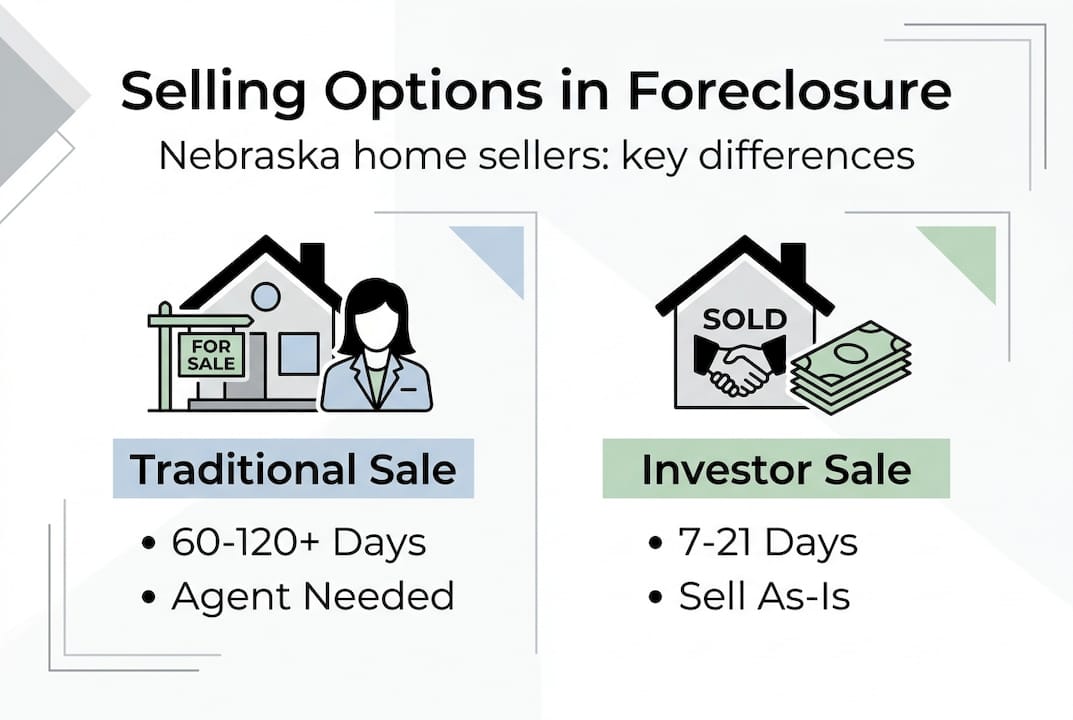
A traditional listing with a real estate agent can take anywhere from 60 to 120 days to close in Nebraska, sometimes longer if the property needs work. That timeline includes listing preparation, showings, negotiations, inspections, and mortgage underwriting. For a homeowner in pre-foreclosure, that's often too slow.
Investor sales compress that timeline dramatically. Most close in under 30 days, and many close in under two weeks. Investor sales can pause foreclosure, providing faster resolution than any traditional listing process. That speed is the core value proposition.
Here's a direct comparison:
| Factor | Traditional listing | Investor sale |
|---|---|---|
| Time to close | 60 to 120+ days | 7 to 21 days |
| Repairs required | Usually yes | No |
| Financing contingency | Common | None (cash) |
| Agent commission | 5 to 6 percent | None |
| Certainty of closing | Moderate | High |
| Price | Closer to market value | Below market value |
| Foreclosure protection | Slow | Fast |
The tradeoff is price. Investors buy at a discount, typically 60 to 80 percent of after-repair value, because they're taking on renovation risk and carrying costs. That's a real cost to you as the seller. But for many homeowners in pre-foreclosure, the alternative is a foreclosure auction that yields even less and destroys their credit.
Review distressed property solutions to understand how the 2026 Nebraska market is shaping up for sellers in your situation. There's also a useful quick sale guide that covers the practical mechanics in detail.
Potential drawbacks of selling to an investor are worth knowing upfront:
- Lower sale price compared to a fully marketed listing.
- Less negotiating leverage if you're under time pressure.
- Varying offer quality since not all investors operate with the same integrity.
- Limited time to review offers when the foreclosure clock is ticking.
- Emotional difficulty in accepting a below-market number for a home you've owned for years.
What to expect from investors: process, pricing, pitfalls
Whether you pick an investor or list traditionally, be prepared for how the process works.
Investor offers for distressed Nebraska properties are calculated using a formula. The investor estimates the after-repair value (ARV) of your home, subtracts renovation costs, carrying costs, and their profit margin, and arrives at a maximum allowable offer. That math is not personal. It's a business calculation based on what the property will be worth after work is done.

Here's a general picture of how investor pricing compares to market value for distressed properties:
| Property condition | Estimated market value | Typical investor offer |
|---|---|---|
| Light cosmetic repairs needed | $200,000 | $155,000 to $170,000 |
| Moderate renovation required | $200,000 | $130,000 to $150,000 |
| Major structural or system issues | $200,000 | $100,000 to $125,000 |
A signed contract with an investor can pause pre-foreclosure proceedings in Nebraska, which is why getting to contract quickly matters so much. The numbers above are ranges, not guarantees. Your actual offer depends on location, specific repairs needed, and current market conditions in Lancaster, Douglas, or Sarpy County.
Here's what the process typically looks like from first contact to closing:
- Initial contact. You reach out to an investor or they contact you. A brief conversation covers the property basics.
- Property walkthrough. The investor visits in person or virtually to assess condition. This is not a formal inspection.
- Written offer. You receive a no-obligation cash offer, usually within 24 to 48 hours.
- Negotiation. You can counter or ask questions. Reputable investors will explain their numbers.
- Signed contract. Once agreed, the contract is signed. This is when foreclosure proceedings can pause.
- Title search and closing prep. A title company handles the legal transfer. This takes 7 to 14 days typically.
- Closing day. You sign documents, the lender is paid off, and you receive any remaining proceeds.
For more resources on the full process, the selling home resources section covers a wide range of scenarios. If your situation involves an inherited property, the selling inherited home guide is also relevant.
Pro Tip: Never accept the first verbal offer as final. Ask the investor to walk you through their ARV estimate and repair cost assumptions. A reputable buyer will do this without hesitation. If they won't explain their numbers, that's a red flag.
Expert perspective: Why real estate investors are changing the Nebraska market
There's a narrative that investors swoop in and take advantage of desperate homeowners. We understand why that story exists. But in Nebraska's distressed property market, the reality is more nuanced.
Investors provide a vital alternative for homeowners needing speed and certainty when traditional buyers simply won't engage. A home with a failed furnace, a compromised foundation, or years of deferred maintenance is not attractive to a family using conventional financing. Banks won't lend on it. Agents struggle to show it. Investors are often the only buyers in the room.
What we've seen in Lancaster, Douglas, and Sarpy counties is that informed homeowners consistently get better outcomes. When you understand the timeline, know your numbers, and approach investor benefits for distressed sellers with clear expectations, the transaction feels less like a rescue and more like a business decision. That shift in mindset matters. You're not a victim of your circumstances. You're a seller making a strategic choice with the options available to you.
Connect with local investors for a fast sale
If you're facing pre-foreclosure or dealing with a distressed property in Nebraska, the most important thing you can do right now is act before the court-confirmed auction date. Every day you wait narrows your options.
At Enko Home Buyers, we buy off-market homes in Lancaster, Douglas, and Sarpy counties. We specialize in properties that need work, and we move fast. Whether you're selling home fast for cash or exploring your options with a selling rental property for cash situation, we can give you a straightforward cash offer with no repairs, no commissions, and no pressure. Reach out today and let's talk about what your property is worth and how quickly we can close.
Frequently asked questions
How long does the Nebraska foreclosure process last?
Nebraska's judicial foreclosure process lasts 142 to 180 days from default to auction confirmation, giving homeowners a real window to sell before losing the property.
Can I sell my home during pre-foreclosure in Nebraska?
Yes. A home sale before auction is possible at any point before the court confirms the sale, and completing that sale pauses the foreclosure process entirely.
What are the main benefits of selling to a real estate investor?
Investor sales offer speed, cash certainty, and as-is purchase terms, which is especially valuable for Nebraska homeowners who can't afford repairs or a long listing timeline.
Do I need to make repairs before selling to an investor?
No. Investors buy as-is and do not require any repairs before purchase, which is one of the primary reasons distressed homeowners choose this route over a traditional listing.