

TL;DR:
- Nebraska home sellers typically face 10 to 13 percent in total selling costs including commissions, taxes, and fees.
- The largest expense is often realtor commissions, which are negotiable and can be reduced in competitive or higher-priced markets.
- Variable costs like repairs, staging, and moving can significantly impact net proceeds, with total expenses sometimes exceeding 13 percent of sale price.
Selling your Nebraska home sounds straightforward until you see the closing statement and realize a chunk of your proceeds has vanished into fees you never planned for. Most sellers focus on the list price and realtor commission, but the actual total selling costs can reach 10 to 13 percent of your sale price, sometimes more. Between transfer taxes, title insurance, staging, repairs, and moving expenses, the numbers add up fast. This guide breaks down every major cost you will face when selling in Nebraska, so you can plan confidently, negotiate smarter, and keep more money in your pocket at closing.
Table of Contents
- Realtor commissions: The biggest selling expense
- Nebraska's documentary stamp tax and transfer fees
- Title fees, insurance, and legal expenses
- Preparation, repairs, and moving: Variable seller costs
- Total selling costs and net proceeds: Putting it all together
- Expert perspective: Cutting hidden costs and maximizing returns
- Make selling easier: Get help with the costs
- Frequently asked questions
Key Takeaways
| Point | Details |
|---|---|
| Commission is top expense | Realtor commissions usually account for 5.5–6% of your Nebraska home's sale price. |
| Transfer taxes are rising | Nebraska’s documentary stamp tax increases in September 2025, so factor this higher cost at closing. |
| Total costs average 13% | Expect all expenses—including commissions and closing fees—to total about 13% of your sale price. |
| Preparation and repairs matter | Staging, moving, and renovations can make up a significant part of selling costs depending on your property. |
| Tax rules can save money | Capital gains exemptions and state taxes affect your profits; check eligibility before selling. |
Realtor commissions: The biggest selling expense
For most Nebraska homeowners, the realtor commission is the single largest expense in the selling process. It feels small as a percentage, but on a $300,000 home, 5.5 to 6 percent translates to $16,500 to $18,000 walking out the door before anything else is deducted.
Traditionally, this commission was split roughly in half between the listing agent (who represents the seller) and the buyer's agent (who represents the buyer). The seller paid both sides. That structure has shifted significantly.
After the 2024 National Association of Realtors (NAR) settlement, rules changed around how buyer's agent compensation works. Now, the buyer's agent commission is no longer automatically bundled into the seller's side. Instead, sellers may offer a concession to help cover the buyer's agent fee, or buyers may negotiate that payment separately. In practice, many Nebraska sellers still end up covering both sides to attract the most buyers, especially in slower markets.
- Listing agent commission: typically 2.5 to 3%
- Buyer's agent commission: typically 2.5 to 3%, now often structured as a seller concession
- Combined total: 5.5 to 6% of sale price
- On a $250,000 home: roughly $13,750 to $15,000 in commissions alone
Understanding Nebraska commission structures before you sign a listing agreement gives you real negotiating power. Some agents will reduce their fee for higher-priced homes or motivated sellers willing to do some of the marketing legwork themselves.
Know this: Commission is almost always negotiable. In competitive markets or for higher-priced homes, many listing agents will accept 1.5 to 2.5% on their side. Even shaving 0.5% off a $350,000 sale saves you $1,750.
Pro Tip: Before signing with any agent, interview at least three and ask directly about their commission flexibility. Review the recent commission changes from the NAR settlement so you walk into that conversation informed.
Now that you understand the main commission expense, let's break down Nebraska-specific taxes and transaction fees.
Nebraska's documentary stamp tax and transfer fees
Nebraska charges a documentary stamp tax (also called a real estate transfer tax) every time a property changes hands. This is one of those costs sellers often forget to budget for, and it is paid by the seller at closing.
The current rate is $2.25 per $1,000 of sale price, which equals 0.225% of your home's value. Starting in September 2025, that rate increases to $2.32 per $1,000. The change may seem small, but on a $400,000 home, it adds up to $928 at the new rate versus $900 at the old one.
Here is how the math looks across different price points:
| Sale price | Tax at $2.25/1,000 | Tax at $2.32/1,000 (post-Sept 2025) |
|---|---|---|
| $150,000 | $337.50 | $348.00 |
| $250,000 | $562.50 | $580.00 |
| $350,000 | $787.50 | $812.00 |
| $500,000 | $1,125.00 | $1,160.00 |
Beyond the documentary stamp tax, sellers also pay recording fees to officially document the transaction with the county. These fees are relatively minor, typically $15 to $16 per document, but they are required and non-negotiable.
Important: Recording fees apply in every Nebraska county, including Lancaster (Lincoln), Douglas (Omaha), and Sarpy. Some counties may have slightly different administrative charges, so always confirm with your title company or closing attorney.
Knowing these seller closing costs well before closing day means you will not be caught off guard when you review your settlement statement.
Beyond transfer taxes, there are essential title fees and closing costs to anticipate.
Title fees, insurance, and legal expenses
Title services are not optional. They protect both the seller and buyer by verifying the property has a clean legal history with no outstanding liens, judgments, or ownership disputes. Skipping or cutting corners on title work can create serious problems that delay or kill a deal entirely.
Here is what Nebraska sellers typically pay for title-related services:
- Title search and examination: Part of the standard title service package, roughly included in the $645 average fee
- Title service fees overall: Average around $645, or about 0.24% of sale price
- Owner's title insurance: Ranges from $1,400 to $1,479, representing 0.5 to 0.55% of the sale price
- Recording fees: $15 to $16 per document filed with the county clerk
Owner's title insurance is a one-time premium that protects the buyer (and the transaction) against future claims arising from past ownership issues. Even though it primarily benefits the buyer, it is typically the seller's responsibility in Nebraska and is expected as part of a clean closing.
Pro Tip: If you are selling a property with a complicated ownership history, an estate sale, or a home you have owned for decades, it is worth investing in a real estate attorney. Attorney fees in Nebraska average around $248 per hour, but even a few hours of legal guidance can prevent costly disputes down the line. The Nebraska closing fees you pay upfront are far less painful than litigation later.
A common mistake sellers make is assuming the title company handles everything automatically. While title companies are thorough, they are not your legal advocate. An attorney reviews the same documents with your interests as the priority, which is a meaningful difference in complex transactions.
Title costs are fixed and predictable, but preparation, repairs, and moving can push costs much higher.
Preparation, repairs, and moving: Variable seller costs
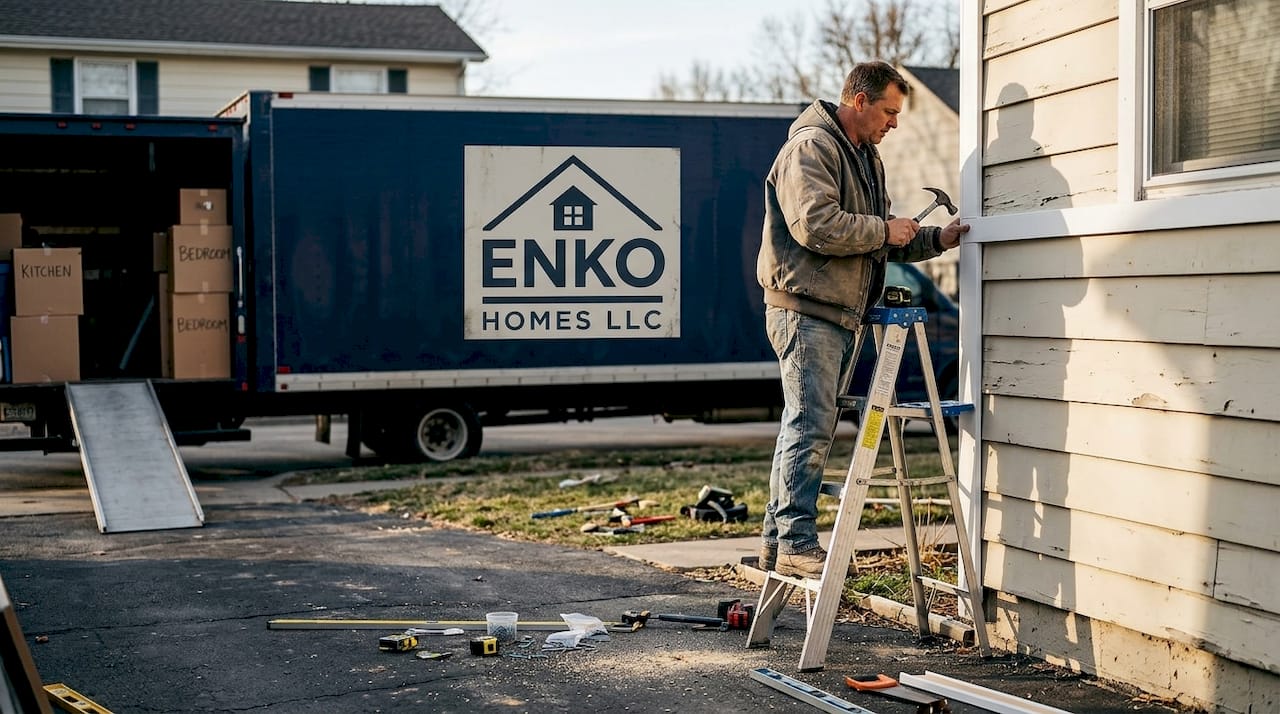
This is where selling budgets most often go sideways. Unlike commissions and taxes, which are tied to a fixed percentage, preparation and repair costs vary enormously based on your home's condition, location, and the current market.
Here is a realistic breakdown of what Nebraska sellers typically spend before and after closing:
- Staging and home preparation: Average cost of $2,800, covering professional staging, deep cleaning, landscaping, and minor cosmetic updates
- Repairs: Costs vary widely based on home condition and repair expenses. A move-in-ready home might need $500 in touch-ups. A distressed or older property could require $15,000 or more in updates to meet buyer expectations.
- Moving costs: Local moves within Nebraska average $1,500 to $2,500. Long-distance relocations can push moving costs up to $4,000 or significantly higher.
- Mortgage payoff: If you still owe on the home, the outstanding balance gets paid from your proceeds. Nebraska sellers carry average mortgage payoffs between $144,000 and $175,000, though this varies dramatically based on how long you have owned the property.
- Attorney fees (optional): At roughly $248 per hour, a few hours of legal review is a smart investment for inherited homes, divorce sales, or complex titles.
Location matters enormously. Costs in Omaha's Douglas County tend to run higher than in rural Nebraska simply due to labor and service costs. Staging a home in Omaha typically costs more than in smaller markets like Beatrice or Norfolk.
| Cost category | Low estimate | High estimate |
|---|---|---|
| Staging and prep | $500 | $5,000+ |
| Repairs | $500 | $20,000+ |
| Moving (local) | $1,500 | $4,000 |
| Attorney | $0 | $1,500+ |
| Mortgage payoff | $0 (paid off) | $200,000+ |
Market conditions also shape these costs. In a slow market, buyers expect concessions, and market demand and concessions become a real negotiating factor. You may end up crediting a buyer for repairs rather than completing them yourself, which shifts the cash outflow but does not eliminate it.
After reviewing variable costs, let's see how all expenses combine for the total net proceeds.
Total selling costs and net proceeds: Putting it all together
Once you add up commissions, transfer taxes, title fees, repairs, staging, and moving costs, Nebraska sellers typically spend 10 to 13% of the sale price to complete a transaction.
On a $300,000 home, that means $30,000 to $39,000 in total selling expenses before you see a single dollar of equity.
Here is how net proceeds look at different sale prices:
| Sale price | Estimated costs (12%) | Estimated net proceeds |
|---|---|---|
| $200,000 | $24,000 | $176,000 |
| $300,000 | $36,000 | $264,000 |
| $400,000 | $48,000 | $352,000 |
| $500,000 | $60,000 | $440,000 |
These figures assume no mortgage balance. If you still owe $150,000 on a $300,000 home, your actual cash in hand after costs drops to roughly $114,000.
Keep in mind: Your net proceeds calculation should also account for taxes. If the home is your primary residence and you have lived there at least 2 of the past 5 years, federal law allows a capital gains exemption of up to $250,000 for single filers and $500,000 for married couples. Nebraska, however, taxes capital gains as ordinary income at a rate around 6.84%, so state taxes may still apply to your profit above your adjusted cost basis.
For inherited homes or investment properties, the tax situation is more complex. Reviewing the Nebraska capital gains rules for your specific situation with a tax advisor can save you thousands in unexpected state tax obligations.
Once you know your total expenses, it is time for perspective on cost-saving and expert strategies.
Expert perspective: Cutting hidden costs and maximizing returns
Here is the part most real estate articles gloss over: sellers have far more control over these costs than they realize, and the conventional approach of listing with a full-service agent and spending big on repairs is not always the smartest financial move.
In our experience working with Nebraska homeowners in Lancaster, Douglas, and Sarpy counties, the sellers who walk away happiest are not necessarily the ones who got the highest list price. They are the ones who genuinely understood their total net proceeds before they started.
Think about staging costs. Spending $3,000 to $5,000 on staging might help you attract more buyers, but it does not guarantee a higher sale price. In a tight market where inventory is low, a clean, well-priced home sells without staging. Spending that money may not add a single dollar to your final proceeds.
The same logic applies to repairs. We regularly see sellers spend $15,000 on updates expecting to recover $20,000 in sale price, only to find that buyers negotiate the price down anyway or that the market simply will not support the premium. Understanding cash buyer strategies gives sellers a legitimate alternative. A cash sale typically means no repairs, no staging, no agent commission, and a faster close.
For distressed homes, inherited properties, or homes with deferred maintenance in Omaha, Lincoln, or the surrounding Sarpy County area, a cash offer from a local buyer often delivers more real money at closing than a traditional listing ever would. You give up the top-line sale price, but you eliminate most of the costs that eat into that number. The net proceeds comparison is often closer than sellers expect.
The mistake we see most often is sellers waiting too long to run the real numbers. Do the math on both paths before you sign a listing agreement. You might be surprised which one actually puts more cash in your hands.
Make selling easier: Get help with the costs
If the numbers in this guide feel overwhelming, you do not have to sort through them alone. Enko Home Buyers works directly with Nebraska homeowners who want a faster, simpler path to closing without the cost surprises that come with a traditional listing.

Whether you are dealing with a property that needs major repairs, an inherited home with a complicated title, or a rental you are ready to exit, we specialize in straightforward cash purchases in Lancaster, Douglas, and Sarpy counties. There are no commissions, no staging costs, and no repair demands. To sell your Nebraska home fast with full transparency on what you will walk away with, reach out to our team. If you own a rental you are ready to exit, learn more about how to sell rental property Nebraska owners can offload quickly without the traditional selling headaches.
Frequently asked questions
Do sellers in Nebraska pay all closing costs?
Sellers typically pay realtor commissions, transfer taxes, and title fees, while buyers generally handle loan origination, appraisal, and inspection fees. The exact split is always negotiable.
How much is the documentary stamp tax when selling a house in Nebraska?
The seller pays $2.25 per $1,000 of sale price currently, with the rate increasing to $2.32 per $1,000 starting in September 2025.
What is the typical cost for title services and insurance in Nebraska?
Title service fees average $645, while owner's title insurance runs $1,400 to $1,479 depending on the property's sale price and history.
How do capital gains taxes affect Nebraska home sales?
Federal law exempts up to $250,000 or $500,000 in gains for primary residences held at least two of the past five years. Nebraska taxes remaining gains as ordinary income at roughly 6.84%.
What should I budget for repairs and moving costs?
Staging and prep average $2,800, moving costs run up to $4,000, and repair expenses vary widely based on your home's condition and location, particularly in higher-cost markets like Omaha.